How to store oyster mushrooms (and how long they last)
Last updated
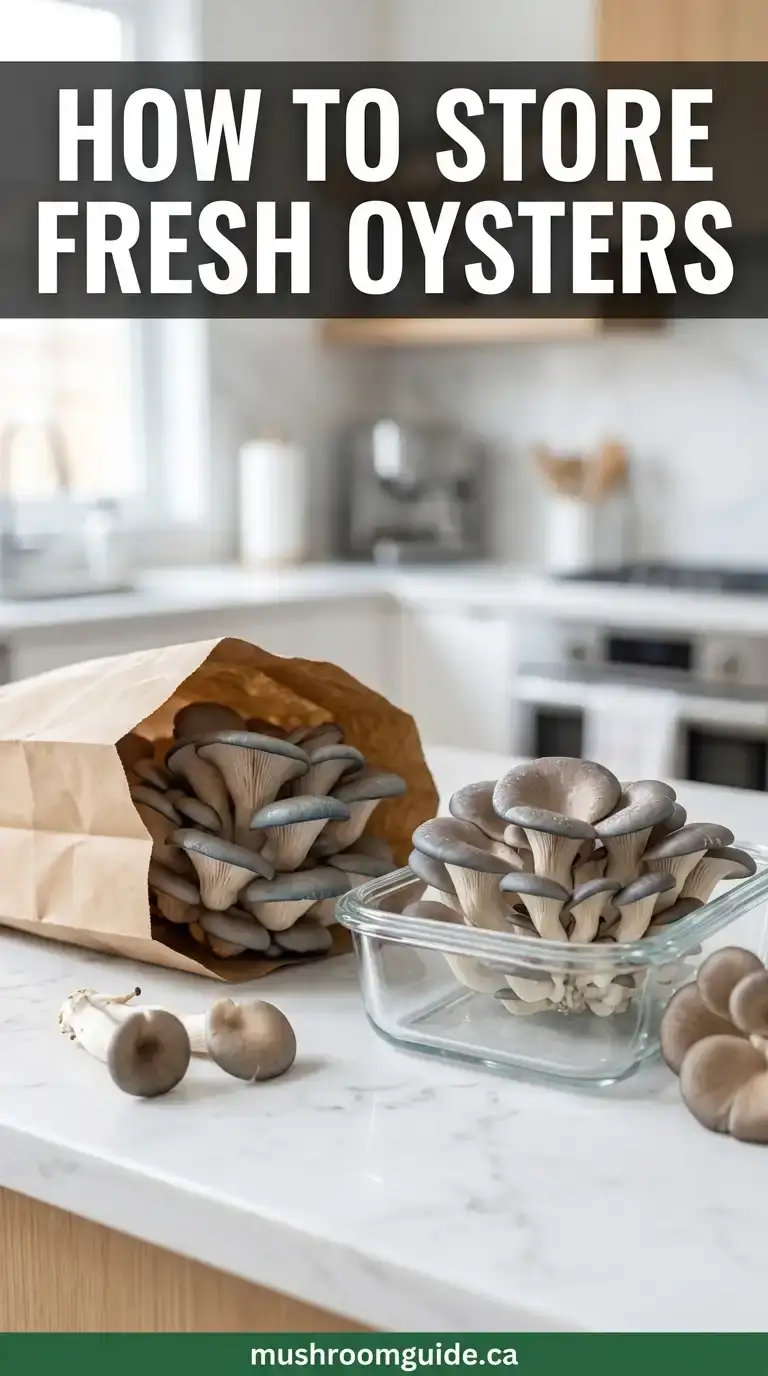
Fresh oyster mushrooms are perishable in a way that grocery store packaging hides. The plastic clamshell they come in is better than sealing them in a Ziploc, but it’s still not optimal — and depending on the variety, you may be cutting their fridge life in half.
This post is the complete storage reference: short-term (days), medium-term (weeks), long-term (months), and what to do with the mushrooms you can’t get to in time.
TL;DR
| Method | Time | Best for |
|---|---|---|
| Paper bag, fridge | 5–10 days | Default — use this |
| Original plastic clamshell | 3–7 days | What grocery stores ship |
| Sealed Ziploc | 1–3 days | Worst — traps moisture, accelerates decay |
| Pickled in jars | 2–4 weeks | Tangy condiment use |
| Cooked, then refrigerated | 4–5 days | Meal prep |
| Frozen (cooked first) | 3 months | Long storage with cooking flexibility |
| Dehydrated, airtight jar | 6–12 months | Best long-term storage |
| Powdered, airtight | 12+ months | Umami seasoning |
How long do they actually last?
This depends on the variety more than you’d think. From freshest to most fragile:
| Variety | Fridge life (paper bag) | Why |
|---|---|---|
| King oyster | 10–14 days | Densest, lowest water content |
| Blue oyster | 7–10 days | Cool-fruiting = thicker caps |
| Grey/pearl oyster | 7–10 days | The standard |
| Pink oyster | 3–5 days | Heat-loving, thin caps, high water |
| Yellow oyster | 3–5 days | Same as pink |
If you’ve harvested at peak (see our variety-specific harvest guides), you get the long end of each range. If you harvested past prime, you’re at the short end or worse.
Short-term: 3–10 days in the fridge
The right method: paper bag
- Don’t wash. Even if there’s substrate residue. Wiping with a damp paper towel is fine; rinsing accelerates decay.
- Place loosely in a brown paper bag — folded closed at the top, not sealed shut. Paper absorbs excess moisture and lets a small amount of air exchange.
- Fridge at 2–4 °C / 36–39 °F, in the main compartment, not the crisper drawer. (Crispers are designed for produce that wants higher humidity; mushrooms want lower.)
That’s it. Don’t overthink it.
Why the clamshell is okay but not great
The plastic clamshells grocery stores use are vented — that’s why they have small slits in the lid. They allow some air exchange while preventing mushrooms from rolling around. They work fine for the first few days but trap moisture as the mushrooms breathe.
If you bought a clamshell, here’s the upgrade: take the mushrooms out, transfer to a paper bag, and toss the clamshell. You’ll get 2–3 extra days.
Why a sealed Ziploc is the worst
Plastic + airtight = condensation. Mushrooms release moisture; the moisture has nowhere to go; the mushrooms sit in their own water and develop slimy patches within 24 hours.
If you absolutely have to use plastic, leave the bag open with the top folded down, not zipped.
What “going bad” looks like
Healthy oyster mushrooms in storage:
- Caps stay mostly intact
- Surface stays dry-to-the-touch (not slimy)
- Mild, faintly sweet, slightly seafood-like aroma
Time to use them now:
- Caps starting to dry at the edges
- Slight loss of vivid colour
- Cap surfaces papery
Past their prime — use immediately in cooked applications:
- Slight wetness on caps but no smell
- Visible drying at the cluster base
Compost — don’t eat:
- Slimy or wet to the touch
- Sour, ammonia, or fishy smell
- Visible mold
- Liquid pooling in the container
The smell test is the most reliable cue. If they smell off, trust your nose.
Medium-term: cooked and refrigerated (4–5 days)
If you have more mushrooms than you’ll cook in a few days, cook them all now, then refrigerate the cooked product. This buys you another 3–5 days and is a much better starting point for weekday meals.
Pan-sauté in a hot pan with a small amount of neutral oil (technique varies by variety — see our air fryer oyster mushrooms and how to cook pink oyster mushrooms guides). Let cool, store in an airtight container in the fridge.
Re-use in:
- Pasta, grain bowls, stir-fries (add at the end, just to warm through)
- Pizza topping (already cooked through = no soggy pizza)
- Frittata or omelette (skip the pre-cook step in those recipes)
- Sandwiches and wraps
To re-crisp cooked oyster mushrooms: hot dry pan for 2 minutes, or air fryer at 380 °F for 3 minutes. Microwaving makes them rubbery.
Pickled oyster mushrooms (2–4 weeks)
Quick-pickling transforms oyster mushrooms into a tangy condiment that keeps for weeks.
Quick pickle recipe (1 jar)
- 250 g fresh oyster mushrooms, torn into bite-size pieces
- ½ cup rice vinegar
- ½ cup water
- 1 tbsp sugar
- 1 tsp salt
- 1 clove garlic, sliced
- 1 bay leaf
- ½ tsp peppercorns
- Optional: thin slice of ginger, dried chili
Method:
- Bring vinegar, water, sugar, salt to a boil in a small saucepan.
- Add mushrooms; simmer 3 minutes.
- Pack mushrooms + aromatics into a clean glass jar.
- Pour hot brine over the top to cover.
- Cool, lid, refrigerate.
Ready in 2 days. Keeps 3–4 weeks. Use on sandwiches, in salads, on charcuterie boards, with grilled meats or tofu.
Long-term: freezing (3 months)
Freeze cooked, not raw. Raw oyster mushrooms turn into a mushy, watery mess when thawed. Cooked mushrooms freeze well and thaw with acceptable texture.
Method
- Pan-sauté the mushrooms with a small amount of oil and salt until they’ve released their water and are just starting to brown.
- Cool completely.
- Portion into flat freezer bags (250 g per bag is convenient).
- Press out the air, seal, freeze flat. Flat = thaws quickly later.
Frozen cooked oysters keep 3 months. Use directly from frozen in soups, stews, pasta sauces, and stir-fries — they’ll release their remaining moisture into the dish.
Don’t thaw and use in dishes that need texture (sandwiches, toppings, garnishes). The texture won’t come back.
Long-term: dehydrating (6–12 months)
The most space-efficient and flavour-preserving long-term storage. Dehydrated oysters become intensely savoury and stable on a pantry shelf.
Method
- Tear or slice mushrooms into uniform pieces (~5 mm thick for slices, bite-size for tears).
- Spread in a single layer on dehydrator trays.
- Dehydrate at 50 °C (120 °F) for 6–8 hours until snap-crisp — you should be able to break a piece cleanly with no bend.
- Cool completely (10 minutes after removing from the dehydrator).
- Store in an airtight glass jar with an oxygen absorber if you have one. Keep in a cool, dark cabinet.
Why “snap-crisp” matters
Mushrooms that bend instead of snapping still contain residual moisture. Stored airtight, they will mold within weeks. The snap test is the single most reliable cue.
Rehydrating
Soak in warm water for 15–20 minutes. Use the soaking liquid too — it’s loaded with flavour. Strain it through a coffee filter to remove any sediment, then use as part of the cooking liquid (stocks, sauces, braises).
No dehydrator?
A low oven (50–65 °C / 120–150 °F) with the door cracked works. Takes 8–12 hours. Less energy-efficient but doable.
Long-term: powdered (12+ months)
Once dehydrated, you can powder oyster mushrooms in a coffee grinder or food processor.
Uses for mushroom powder
- Umami booster: stir into stocks, broths, pasta water, gravies, sauces
- Seasoning blend base: mix with salt, pepper, garlic powder, dried thyme for a custom seasoning
- Burger / meatball seasoning: 1 tsp powder per 500 g ground meat or plant-based protein
- Risotto / polenta: stir 1 tbsp powder into the cooking liquid
- Tea / broth on its own: 1 tsp in 250 mL hot water with a pinch of salt makes a quick savoury drink
Store in an airtight glass jar in a cool, dark cabinet. Keeps 12+ months with minimal flavour loss.
A few storage scenarios
“I bought a clamshell at the store”
Take them out, paper bag, fridge. Now you have 7–10 days instead of 5–7.
“I harvested a 5-gallon bucket — way more than I can eat”
Cook half, freeze that. Dehydrate the rest. Now you have weekday meals + 6 months of mushroom-flavoured everything.
“I went away for a week and there are mushrooms in my fridge”
If they were grey/blue/king oyster and you stored them in a paper bag: probably still fine. Smell test, then cook fully.
If they were pink or yellow oyster, or stored in plastic: more likely spoiled. Trust the smell. When in doubt, compost.
“I bought too many at the farmer’s market”
Pickle a jar. Cook and refrigerate another portion. Dehydrate the rest. You’ve now bought yourself 6+ months of mushroom flavour from a single market visit.
Spore safety reminder
If you grew the mushrooms yourself, wear an N95 mask during processing (slicing for dehydration, packaging) and ventilate the room. Even dried mushroom processing releases spore-like particulates that can cause hypersensitivity pneumonitis (“mushroom worker’s lung”) with repeated unmasked exposure.
For store-bought mushrooms that are days old, spore release is much lower, but processing 1+ kg at a time in a closed kitchen will still fill the air with measurable particulates. Open a window.
Related guides: Air fryer oyster mushrooms, How to cook pink oyster mushrooms, and the harvest-timing guides for each variety in Grow.