Mushroom jerky recipe (king oyster, the only one worth it)
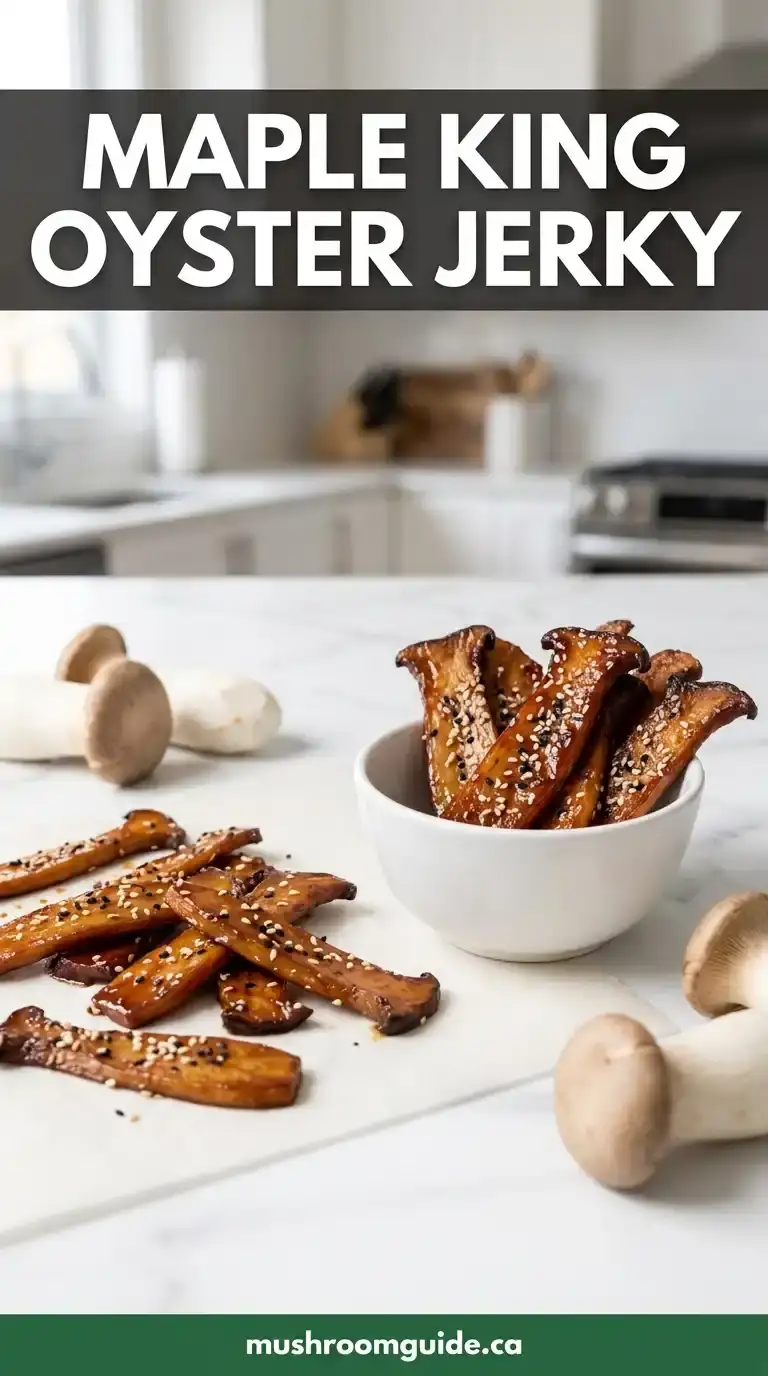
Mushroom jerky is one of the best ways to use a glut of king oyster harvest. Done right, it’s chewy, deeply savoury, almost smoky, and shelf-stable for months in a sealed jar. Done wrong, it’s brittle shards that taste like dust.
This post is the recipe that works, with notes on why almost every other “mushroom jerky” technique online is wrong. Use king oyster, not oyster, not lion’s mane. There’s a reason.
TL;DR
- King oyster mushrooms are the only species that gives proper jerky texture
- Sliced lengthwise, 4–5 mm thick — not too thin, not too thick
- Marinade for 4–6 hours, not overnight (over-marinated = mushy)
- Dehydrator at 60 °C / 140 °F for 6–8 hours, until chewy-pliable, not crisp-snap
- Brushing maple syrup on at the end gives the dark, caramelized finish good jerky has
- Keeps 2 months in a sealed jar at room temp, 6+ months refrigerated
Why king oyster (and only king oyster)
Three species are commonly suggested for mushroom jerky online. Here’s what actually happens:
| Species | Result | Why |
|---|---|---|
| King oyster | ✅ Chewy, dense, holds shape | High dry-weight density, low moisture, thick fibres |
| Oyster (any colour) | ❌ Brittle, crumbly, shatters | Thin caps, dries to dust |
| Lion’s mane | ❌ Spongy, falls apart | Internal cavities don’t compress; tears during dehydrating |
| Shiitake | ⚠️ OK but tough | Closer to mushroom-leather than jerky |
| Cremini / portobello | ⚠️ Decent but low yield | Too much water loss; needs aggressive thickness |
King oyster is the right tool. If you don’t have king oyster, make a different recipe.
What you need
Ingredients (makes ~120 g finished jerky)
- 500 g fresh king oyster mushrooms (about 3–4 large stems)
- 3 tbsp soy sauce
- 1 tbsp Worcestershire sauce
- 1 tbsp rice vinegar or apple cider vinegar
- 1 tbsp maple syrup, plus 1 tbsp more for brushing
- 1 tsp smoked paprika
- 1 tsp garlic powder
- 1 tsp onion powder
- ½ tsp black pepper
- Optional: ½ tsp liquid smoke, ½ tsp chili flakes, ¼ tsp ground cumin
Equipment
- A food dehydrator with adjustable temperature down to 50–60 °C. Most Canadian-available models work — Excalibur, Cosori, Nesco, and budget Amazon.ca dehydrators all do this fine. Stay away from dehydrators that only have a single fixed temperature (often labeled “for food”).
- A sharp knife
- A wide bowl or large zip-top bag for marinating
If you don’t have a dehydrator, a low oven (60 °C with the door cracked) also works. Same timing.
Affiliate note: We’re an Amazon Associates participant — if you click a dehydrator link from this site and buy one, we earn a small commission at no cost to you. See our full affiliate disclosure.
The method
Step 1: Prep the mushrooms (10 min)
- Wipe the king oyster stems clean with a damp paper towel. Don’t wash them — they absorb water.
- Trim the caps off and set aside (use them for stock or another dish; they’re not great for jerky).
- Slice the stems lengthwise into 4–5 mm thick planks. Too thin = brittle. Too thick = won’t dehydrate evenly.
Step 2: Marinate (4–6 hours)
- Whisk all marinade ingredients in a bowl. Taste — should be distinctly salty and savoury. Adjust if needed.
- Add the mushroom planks; toss to coat every surface.
- Transfer to a zip-top bag, press out the air, refrigerate.
- 4–6 hours is the right window. Less than 4 = under-flavoured. Longer than 8 = the planks turn mushy from osmotic water loss.
Halfway through marinating, flip the bag.
Step 3: Dehydrate (6–8 hours)
- Drain the planks. Don’t rinse. Pat the surface lightly with a paper towel to remove pooled marinade (which would prolong drying).
- Arrange in a single layer on dehydrator trays, with at least 1 cm space between pieces.
- Set the dehydrator to 60 °C / 140 °F.
- Run for 6 hours, then start checking every 30 minutes.
Doneness test: the jerky should be pliable, not brittle. Bend a piece — it should fold without cracking. If it snaps cleanly, it’s overdried. If it feels wet or sticky, it needs more time.
Typical total: 6–8 hours. Thicker pieces take longer.
Step 4: Finish (optional, 10 min)
For a darker, slightly sweeter glaze:
- After dehydrating, brush both sides of each piece with maple syrup.
- Return to the dehydrator at 60 °C for 30 minutes to set the glaze.
- Cool completely before packaging.
This step is optional but it’s what separates “good” mushroom jerky from “actually wow” mushroom jerky.
Step 5: Store
- Airtight glass jar, room temp: 2 months
- Airtight glass jar, refrigerated: 6+ months
- Vacuum-sealed bag: 12 months
- Frozen: indefinitely (but defrosts to mushy if it absorbed ambient moisture during dehydration)
For longest shelf life, dry slightly past pliable into “snap with visible bend.” Less satisfying immediately, far longer-keeping.
Common mistakes
1. Slicing too thin
Tempting because you think “thin = chewy jerky.” Wrong. Thin king oyster slices dry into brittle shards that crumble. 4–5 mm is the sweet spot.
2. Over-marinating
Mushrooms are sponges. After 6+ hours in a salty wet marinade, they draw too much liquid in, lose structural integrity, and turn into soft strips that never properly dehydrate. 4–6 hours.
3. Crowding the dehydrator trays
Same as crowding a pan — overlapping pieces won’t dry evenly. Single layer, with visible gaps between pieces.
4. Dehydrating too hot
Some recipes suggest 70 °C+. Too hot drives moisture off the surface faster than the interior can release it, leaving a chewy outside and wet inside that will mold within days. 60 °C is the right number.
5. Stopping too early
Pliable, not soft. If you bend a piece and it feels “spongy,” it’s not done. Keep going.
6. Using oyster or lion’s mane
We mentioned this above. Try it once if you must. You’ll come back to king oyster.
Variations
Smoky maple
Increase liquid smoke to 1 tsp. Add 1 tbsp maple to the finishing brush instead of 1 tbsp.
Spicy
Add 1 tsp gochujang or 1 tsp chili crisp to the marinade. Don’t go much higher — the flavour concentrates as the jerky dehydrates.
Teriyaki
Replace the soy/Worcestershire/maple with 4 tbsp teriyaki sauce + 1 tbsp rice vinegar + 1 tsp grated ginger. Finishing brush: more teriyaki.
Salt and pepper (Chinese-restaurant style)
Skip the marinade entirely. Toss with 1 tbsp neutral oil + 1 tsp flaky salt + 1 tsp Sichuan peppercorns (lightly crushed) + ½ tsp white pepper + ¼ tsp five-spice powder. Dehydrate plain. Lighter, drier result; more snacky than chewy.
What to do with the leftover caps
The caps of king oyster aren’t ideal for jerky but they’re useful for:
- Slicing thin and sautéing as a side dish (they’re more delicate than the stems)
- Drying separately and powdering for an umami seasoning base
- Adding to stock alongside dried oyster or shiitake
Don’t waste them.
How much jerky from one grow block?
A 5 lb (2.3 kg) king oyster grow block produces ~1.0–1.4 lb (450–650 g) of fresh fruit across two flushes. Use our yield estimator for your specific setup.
After dehydrating, that’s roughly 80–110 g of finished jerky per block. Two grow blocks = a solid jar of jerky for two months.
Spore safety reminder
When breaking up larger king oyster fruiting bodies or processing multiple kilos of mushroom at once, wear an N95 mask. Even at the prep stage, fungal cell-wall particulates released by tearing and slicing can cause hypersensitivity pneumonitis (“mushroom worker’s lung”) with repeated unmasked exposure. Open a window when you’re processing.
Related guides: How to grow oyster mushrooms in Canada, When to harvest king oyster mushrooms, and our yield estimator for sizing your harvest before you start the jerky line.
Prefer it on paper? This recipe is one of the printable recipe cards — one page, ingredients and method.