When to harvest king oyster mushrooms
Prices and availability checked . Canadian retail moves and suppliers change — verify before buying.
King oyster mushrooms (Pleurotus eryngii) are the heavyweight champions of the oyster family. They grow slower than their cousins. They get dramatically larger — single fruiting bodies of 100–250 g are normal. And the harvest cues are completely different from grey, blue, pink, or yellow oysters.
If you’ve grown other oysters and applied your usual harvest timing to king oysters, you almost certainly picked them too early — and missed the meaty stem density that makes king oyster the “vegan scallop” of the cultivated mushroom world.
This guide is about reading king oysters specifically.
TL;DR
- Harvest 10–14 days after pinning. Slower than other oysters. Patience is the whole game.
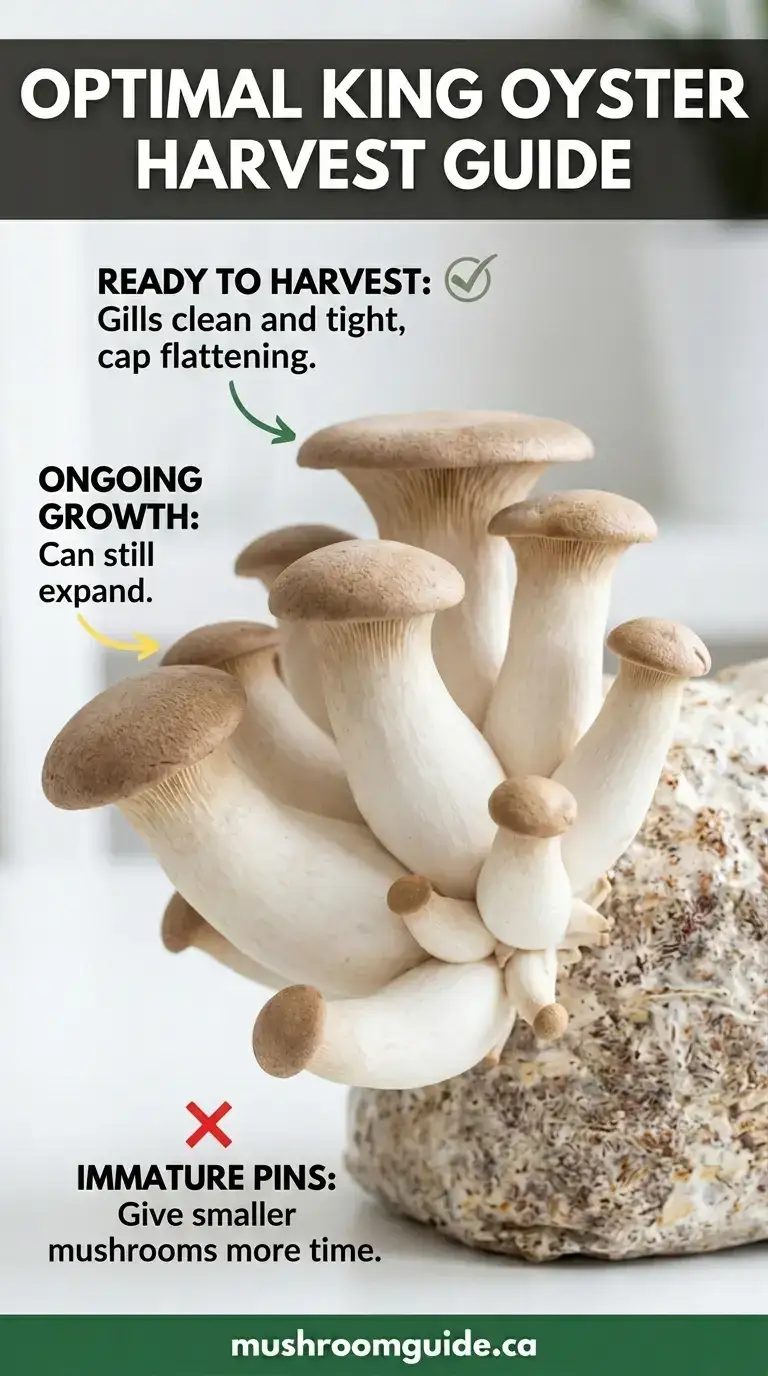
- Pick when the caps just begin to flatten — but the stem has reached full thickness. The stem matters more than the cap with this species.
- Cap diameter ≈ ⅓ to ½ of stem length at peak harvest.
- You can leave them on the block longer than you’d think. Past prime is later than for any other oyster.
What makes king oyster different
Three things separate king oyster from every other cultivated oyster:
1. The stem is the product
With grey, blue, pink, and yellow oysters, the cap is the prize and the stem is something you trim off and compost. With king oyster, the stem is the prize — it’s the dense, scallop-textured cylinder that holds up to high-heat searing, slicing into coins, and grilling.
The cap of a cultivated king oyster, while edible, is comparatively small and less prized. Many restaurants and recipe sites use only the stems.
This inverts the harvest timing logic. You’re not optimizing for the cap; you’re optimizing for stem thickness and density.
2. They fruit one at a time, not in clusters
A king oyster block produces 2–6 individual fruiting bodies that emerge independently, not as a tight cluster. Each one matures on its own timeline. You’ll often harvest them across 5–7 days, not all at once.
3. The pin-to-harvest cycle is 50% longer
While pink oysters are ready in 4–6 days and grey oysters in 5–7, king oysters take 10–14 days from pinning to peak harvest. Growers who give up early or assume something’s wrong miss the actual harvest window entirely.
The king oyster timeline
| Stage | Days from pinning | What it looks like |
|---|---|---|
| Primordia | Day 0 | Tiny white-grey bumps emerging from the substrate surface or air-cuts |
| Early pins | Day 1–3 | Recognizable mini-mushroom shape — small cap on a stubby stem |
| Stem elongation | Day 3–8 | Stem thickens and lengthens; cap stays small and tight |
| Stem maturity | Day 8–11 | Stem reaches full diameter (often 3–5 cm); cap begins enlarging |
| Harvest window | Day 10–14 | Cap diameter ≈ ⅓ to ½ of stem length; stem fully dense; cap just starting to flatten |
| Past prime | Day 15+ | Cap fully flat or starting to upturn; visible sporulation may begin |
The slow timeline means you usually have 24–48 hours of grace at the harvest window — much more forgiving than pink or yellow oysters.
The three harvest cues
1. Stem density — squeeze test
Press the stem gently between thumb and forefinger near the middle.
- Spongy, gives way easily, returns slowly: too early. Stem hasn’t fully developed cell wall structure. Texture will be soft and uninteresting after cooking.
- Firm, slight give, springs back quickly: perfect. This is the texture you want for searing and slicing.
- Rock-hard, no give: past prime. The mushroom is starting to dry out and develop a slightly woody texture.
This is the single most important cue for king oyster. If you only remember one thing, remember the squeeze test.
2. Cap-to-stem ratio
Look at the mushroom from the side. The cap should be:
- <¼ of the stem length: too early.
- ¼ to ½ of the stem length: perfect harvest window.
- >½ of the stem length, or cap visibly flattening and curling at edges: past prime.
Don’t be afraid of a small cap. With other oysters, a small cap means “wait.” With king oyster, a small cap on a thick stem means “harvest now.”
3. Cap colour and texture
Young king oyster caps are pale tan to fawn brown and slightly domed. As they mature, caps:
- Lighten slightly
- Spread out
- Develop concentric ridges or a faintly cracked surface texture
The harvest window is open as long as the cap is still mostly intact (no major splits) and the colour is uniform tan/brown — not bleached or papery.
When to harvest each individual fruiting body
Because king oysters mature one at a time:
- Check the block daily starting day 8 after pinning.
- When one fruiting body passes the squeeze test and hits the cap-to-stem ratio, twist it off at the base with a gentle counter-clockwise motion. Don’t cut — twisting cleanly releases the mushroom from the substrate.
- Leave the others. They’re on their own timeline.
- The block continues fruiting for 7–10 days as remaining mushrooms mature.
A typical 5 lb (2.3 kg) block produces 2–4 fruiting bodies in the first flush, with a smaller second flush 10–14 days later.
What if you missed the window?
Slightly past prime (cap visibly flat, no other issues): still excellent. Texture is slightly drier; slice the stems into 1 cm coins and sear in oil. Cap is best torn off and cooked separately for soup or stock.
Significantly past prime (cap upturned, edges drying): stem still usable for slicing; cap is mealy. Dehydrate the cap for stock; use the stem within 2 days.
Cap has split open or developed a cracked surface: stem texture is already compromised. Use immediately, only in long cooking applications (stew, braise) where texture isn’t the point.
Visible sporulation: the mushroom is dropping cap and beginning to break down. Harvest immediately, refrigerate, use that day.
Why timing matters specifically for king oyster
The stem-as-product logic changes everything about cooking. King oysters harvested at peak develop a dense, fibrous internal structure that:
- Sliced crosswise into coins: sears like scallops. The famous “vegan scallop” application.
- Sliced lengthwise into planks: grills like a steak.
- Torn lengthwise into strands: pulls apart like roast pork, which is the basis of “pulled mushroom” sandwich recipes.
- Diced into cubes: holds shape in stir-fry like firm tofu.
A king oyster picked too early collapses into a soft, watery mass when heated. It’s not bad — it’s just an entirely different (and inferior) ingredient.
Yield
Use our yield estimator for your specific setup. For king oyster on supplemented hardwood sawdust, growers commonly report — these are typical results rather than a yield you are owed, and strain, substrate and environment move them a long way:
- First flush: 30–40% biological efficiency
- Second flush: 15% if it happens at all
- Total expected from a 5 lb (2.3 kg) block: 1.0–1.4 lb (450–650 g) fresh
Lower than oyster, but the per-mushroom value is dramatically higher. King oyster sells for $15–25/lb at Canadian specialty grocers when available — which it usually isn’t.
Storage
King oysters are the longest-keeping cultivated mushroom:
- Refrigerator (2–4 °C) in a paper bag: 10–14 days
- Refrigerator in a vented clamshell: 7–10 days
- Dehydrated and stored airtight: 6+ months
- Frozen (sliced and sauteed first): 3–4 months
The dense stem structure that holds up to high-heat cooking also holds up to extended refrigeration. Even at day 10–14 in the fridge, a king oyster stem will sear properly if you slice it fresh.
Spore safety reminder
Wear an N95 mask when harvesting and ventilate the room. King oysters are lighter sporulators than other oysters — but “lighter” is relative; they still release enough spores to cause hypersensitivity pneumonitis (“mushroom worker’s lung”) with repeated unmasked exposure.
Common mistakes
| Mistake | What happens | Fix |
|---|---|---|
| Picking like other oysters (5–7 days post-pin) | Too early — soft, watery texture | Wait until day 10–14 |
| Picking when the cap looks “right” | Cap timing is wrong with this species | Use the stem squeeze test |
| Trimming the stem aggressively | Wasting the actual product | Use the stem; cook the cap separately or in stock |
| Slicing thin | Loses the scallop texture | Slice into 1 cm coins or 1.5 cm planks |
| Cooking without high heat | Steams instead of sears | Hot pan, smoking oil, salt at the end |
Related: Air fryer king oyster mushrooms — scallops and “bacon” from the stems you just harvested, and how long each cut takes. King oyster vs oyster vs lion’s mane — the scallop-stem texture in cooking context. Mushroom jerky recipe — king oyster is the only species that makes proper jerky texture. Best mushroom grow kits in Canada — which kits carry king oyster, and what else you need. How to grow oyster mushrooms in Canada — growing methods that work for king oyster too. How to store oyster mushrooms — king oyster is the longest-keeping cultivated mushroom at 10–14 days. When to harvest blue oyster mushrooms — the cold-loving cousin. When to harvest pink oyster mushrooms — the fastest oyster.