When to harvest blue oyster mushrooms
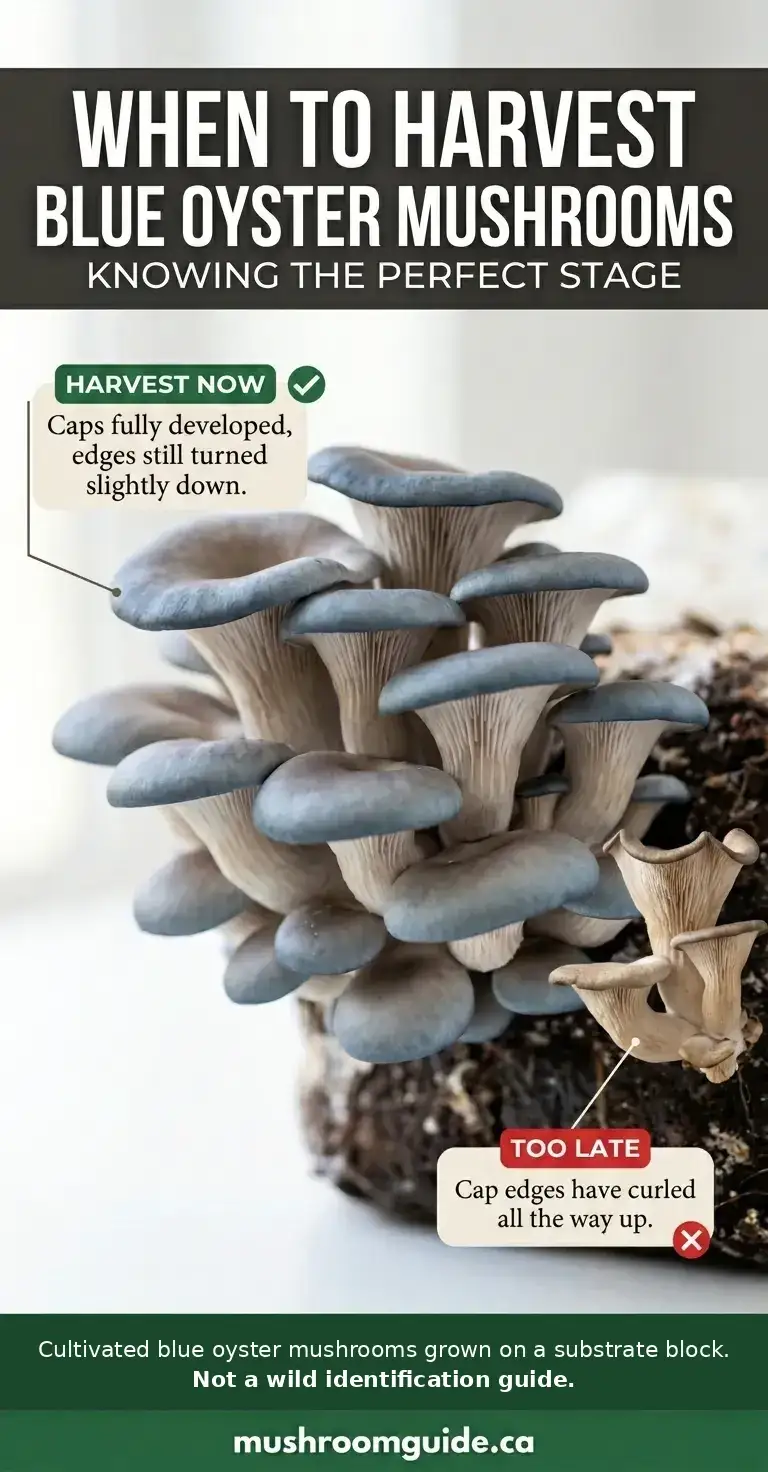
Blue oyster mushrooms (Pleurotus ostreatus var. columbinus) are the cold-loving cousin of grey oyster — same shape, same texture, same yield, but they fruit happily at temperatures that stall most other species. Their fruiting range runs 10–18 °C, and the comfortable band inside it is 13–18 °C (55–65 °F). That makes them the best fall, winter, and unheated- basement mushroom in Canada.
But “cold-loving” also means the harvest window is a moving target. Pick the same cluster at 14 °C and at 20 °C and you’ll have very different timelines. This post is about reading the mushroom itself, not the calendar.
TL;DR
- Harvest 5–7 days after pinning at 15–18 °C. Faster (3–5 days) above 20 °C.
- Pick when caps flatten and the edges just start to lift — not when they’re already wavy.
- The “blue” colour fades as the mushroom matures. Strongly blue/grey = young. Pale grey or buff = past prime.
- Cool fruiting chambers slow everything down, including spoilage. You usually have 1 extra day of grace vs. pink or yellow oysters.
The blue oyster timeline
Blue oysters pin in dense, fast clusters. The pin-to-harvest curve looks like this at typical Canadian indoor temperatures:
| Stage | At 15–18 °C | At 20–24 °C | What you see |
|---|---|---|---|
| Primordia | Day 0 | Day 0 | Tiny blue-grey dots clustering on the substrate |
| Early pins | Day 1–2 | Day 1 | Distinct mini-oyster shapes, deep slate-blue |
| Cap formation | Day 3–4 | Day 2–3 | Recognizable caps, still strongly curled under |
| Harvest window | Day 5–7 | Day 3–5 | Caps mostly flat, edges still down or just lifting |
| Past prime | Day 7–8 | Day 5–6 | Edges wavy, caps fading to pale grey, sporulation starting |
| Spoilage risk | Day 8+ | Day 6+ | Sour/funky smell, slimy edges |
The takeaway: cold fruiting chambers extend the harvest window by roughly 2 days. That’s why blue oysters are forgiving for hobby growers who can’t check the chamber every 12 hours.
The three harvest cues
1. Cap shape — flat with edges just turning up
The most reliable signal. Blue oyster caps go through a predictable arc:
- Cupped under (concave from above, edges tucked) → too early. Cluster looks like a bunch of tightly closed clams.
- Mostly flat with edges still down or barely starting to lift → perfect. Cluster looks like an open palm.
- Wavy, uplifted, gills visible from the side → past prime. Texture will be tougher and you’ve lost some of the storage life.
2. Colour — slate-blue, fading to grey
Young blue oysters are visibly blue — slate, gunmetal, sometimes nearly navy at the cap edges. As they mature, the blue fades to grey, then to buff or cream. By the time the caps look beige, you’ve waited too long.
The blue colour is more pronounced in cooler chambers. A blue oyster grown at 16 °C is dramatically more pigmented than the same strain grown at 22 °C — that’s normal, not a problem.
3. Sporulation — white dust = harvest now
Blue oysters are heavy sporulators. Once you see a fine white dust accumulating on lower caps, on the substrate, or on the chamber walls, you have hours to harvest before the cluster starts breaking down.
If you tap the cluster gently and a visible puff of spores releases, you’re already past prime — harvest immediately, wear an N95.
What makes blue oyster different from grey
They’re so closely related (botanically the same species, different variety) that most cultivation advice transfers directly. The genuine differences:
- Cold tolerance. Blue fruits below 15 °C; grey often stalls.
- More dramatic colour. Greys are brown-grey; blues are visibly blue when fresh.
- Slightly denser caps. Blue oysters hold up better in cooking and store ~1 day longer than greys.
- Same yield range. Both deliver ~80–100% BE across two flushes on Masters Mix.
What to do if you missed the window
Slightly past prime, no smell: still good. Trim any dry or papery edges, cook the same day. Texture will be a bit chewier than peak harvest.
Visible sporulation, no smell: harvest, trim aggressively (cut off any spore-dusted cap surfaces), refrigerate, use within 2 days.
Funky/sour smell: compost. Bacterial spoilage in oysters has caused documented food poisoning — don’t push your luck.
Cluster has dried out (papery, brittle): this is actually salvageable. Snap the dried caps off and run them through a coffee grinder for mushroom powder. It’s an excellent umami booster for stocks, sauces, and seasoning blends.
The cold-chamber temperature trap
Blue oysters are so happy through 10–18 °C that growers sometimes assume “colder = better.” Below 12 °C, fruiting slows dramatically; below 10 °C it can stop entirely. The substrate also takes much longer to recover between flushes.
The sweet spot for yield is closer to 16–18 °C — cool enough to preserve the blue colour and slow the harvest window, warm enough to actually fruit aggressively.
Storing fresh blue oysters
Blue oysters are the best-keeping oyster — better than grey, pink, or yellow:
- Refrigerator (2–4 °C) in a paper bag: 7–10 days
- Refrigerator in a vented plastic clamshell: 5–7 days
- Dehydrated and stored airtight: 6+ months
- Frozen (sauteed first): 3 months
The dense, slightly thicker caps that come from cold fruiting hold up better in storage than the thinner caps you get at higher temperatures.
Spore safety reminder
Wear an N95 mask when harvesting and ventilate the room. Blue oysters are among the heaviest sporulators in cultivation — even a “perfect” harvest will release visible spore clouds when you handle the cluster.
Repeated spore exposure can cause hypersensitivity pneumonitis (“mushroom worker’s lung”), a real and well-documented condition in commercial mushroom workers. For hobby growers harvesting weekly, one year of unmasked harvests is enough exposure to cause symptoms in sensitive people.
If you see spore dust accumulating on the substrate before you harvest, the FAE rate in your chamber is too low, your harvest timing is too late, or both.
Related: How to grow oyster mushrooms in Canada — the bucket method works for blues; cool basements are perfect. Best mushroom grow kits in Canada — where the blue oyster blocks come from in the first place. Air fryer oyster mushrooms — the dense blue caps hold up beautifully to high heat. How to store oyster mushrooms — blues are the best-keeping oyster at 7–10 days. When to harvest pink oyster mushrooms — the fastest, most unforgiving oyster. When to harvest white oyster mushrooms — the most common Canadian grocery-store variety.