When to harvest pink oyster mushrooms
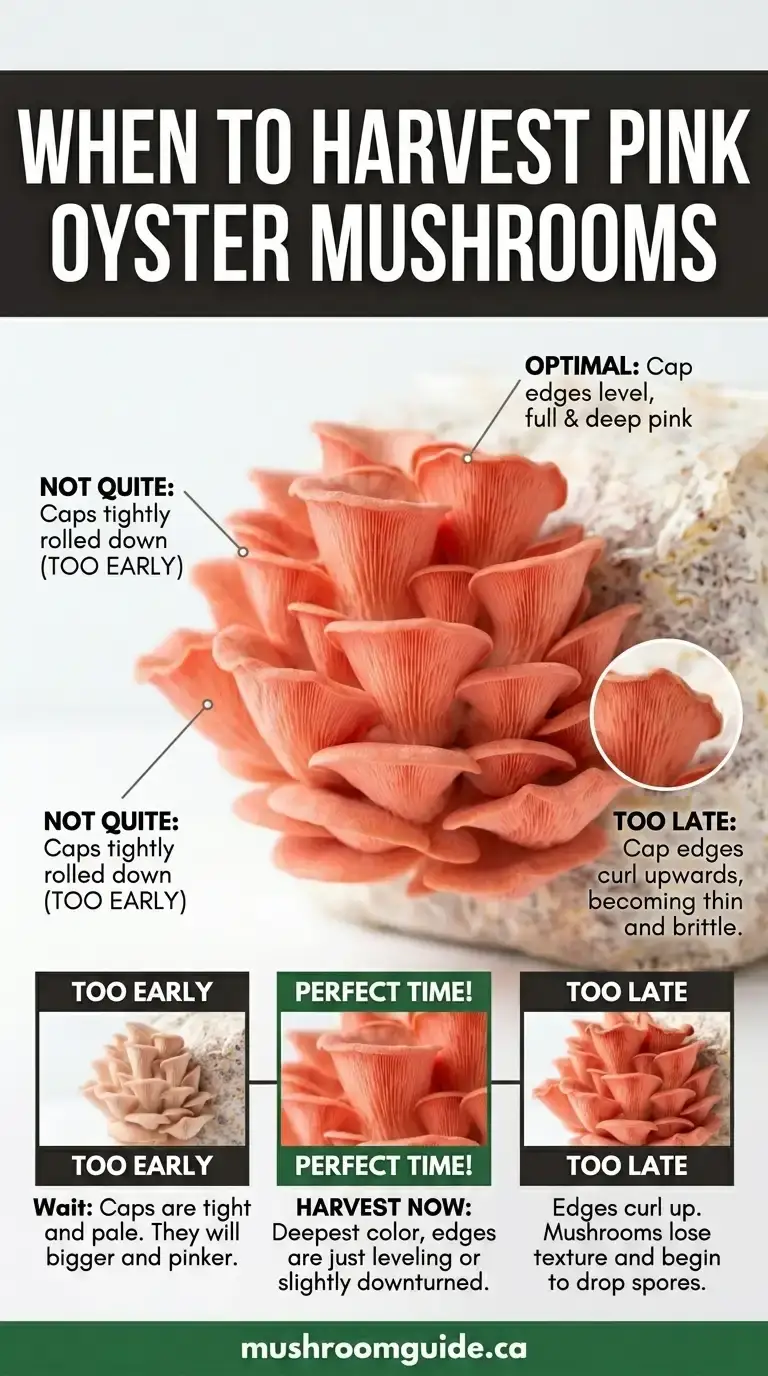
Pink oyster mushrooms (Pleurotus djamor) are the fastest-fruiting oyster you can grow — and the most unforgiving. From first pin to “should have picked this yesterday” is often less than a week. Get the timing right and they’re spectacular. Get it wrong and you have a sour, slimy cluster and a fruiting chamber that smells like fish.
This guide is about the harvest window only — when to pick. For the full grow guide, see How to grow pink oyster mushrooms in Canada (coming soon).
TL;DR — the three rules
- Harvest 4–6 days after pinning. Pink oysters are the fastest oyster in cultivation. If you grow other oysters and use a 5–7 day rule, that’s already a day too late for pinks.
- Pick when the caps flatten and the edges start to turn up — not when they’ve finished. With pinks, by the time edges are clearly wavy, you’ve missed it.
- If you smell anything fishy or sour at any point, harvest immediately. That smell is the first sign of bacterial spoilage and gets worse by the hour.
How pink oysters grow (timeline)
Pink oysters fruit aggressively at warm temperatures (24–30 °C / 75–86 °F), which is part of why they’re so fast — and why they’re popular for indoor Canadian grows, especially in summer when colder-loving species struggle.
A typical fruiting cycle:
| Stage | Days from pinning | What it looks like |
|---|---|---|
| Primordia | Day 0 | Tiny pink dots clustering on the substrate |
| Early pins | Day 1–2 | Bright magenta-pink “fingers” emerging |
| Cap formation | Day 3–4 | Distinct oyster-shaped caps, still curling under |
| Harvest window | Day 4–6 | Caps flat or just-flattening, edges still mostly tucked or just lifting |
| Past prime | Day 6–7 | Caps fully wavy and uplifted, beginning to drop spores, colour fading to pale pink/cream |
| Spoilage risk | Day 7+ | Sour smell, slimy edges, fast bacterial breakdown |
That cap-flattening signal is the single most important visual cue. With slower-fruiting white or grey oyster strains, you have a day or two of grace on either side. With pinks, you have hours.
The three harvest cues (in order of reliability)
1. Cap shape — flat with edges just starting to lift
Pink oysters start with caps that curl tightly under (concave from above). As they mature, the caps flatten, then begin to turn upward at the edges, then go fully wavy.
- Too early: caps still strongly cupped, edges tucked under, cluster looks like a tight pink bouquet
- Perfect: caps mostly flat across the top, edges still down or only just beginning to upturn — the cluster looks like an open hand
- Too late: edges clearly wavy and uplifted, you can see the gills facing slightly outward instead of straight down
2. Colour — bright magenta-pink, not pale
Fresh pink oysters are saturated, almost shocking pink. As they age past prime, the colour fades — first to a softer rose, then to pale pink or cream. Faded clusters are losing freshness and have started releasing spores.
This colour change is faster on the cap tops (which see more light and air) than on the gills underneath, so the gills can still look vivid while the tops have already faded. Trust the tops.
3. Smell — neutral and faintly sweet, never fishy
Healthy pink oysters smell mild, faintly sweet, slightly seafood-like in a pleasant way (people sometimes call it “bacon-like” or “lobster-like” — the flavour matches).
A fishy, sour, or ammonia-like smell is your hard stop. That’s bacterial spoilage starting, and it accelerates within hours. Harvest the whole cluster immediately, trim aggressively, refrigerate, and use that day. Do not eat anything that still smells off after cooking.
Why pinks are so unforgiving
Three reasons specific to P. djamor:
- Heat-loving = fast metabolism. Warm-fruiting species blast through their fruiting cycle faster than cooler-fruiting ones.
- Heavy sporulator. Pink oysters release a lot of spores, fast. Once sporulation starts, the cluster begins to break down quickly.
- High water content + thin caps. Pink oysters bruise easily and lose structural integrity faster than meatier oyster strains like king oyster.
The net effect: the harvest window is narrow. Plan to check your fruiting chamber at least twice a day once you see pins.
What if you have to harvest early or late?
Slightly early (caps still partly cupped): fine. The cluster will store better than a perfect-stage harvest and will continue to flatten somewhat in the fridge. Slight yield trade-off — maybe 10–15% lighter than a peak-stage harvest.
Slightly late (edges wavy but no smell): still usable. Trim any papery, dried-out edges, cook the same day or dehydrate immediately. Texture will be a little tougher.
Late with smell: compost. Don’t risk it. Bacterial spoilage in oysters has caused genuine food poisoning — this is not a “you’ll just get a stomachache” situation.
Storing fresh pink oysters
Even at peak harvest, pinks are the worst-keeping oyster. Fridge life is 3–5 days max, vs. 7–10 days for white or grey oysters.
To extend:
- Refrigerate at 2–4 °C in a paper bag (not plastic — traps moisture)
- Dehydrate within 24 hours for shelf-stable storage (rehydrate in warm water for ~15 min before cooking)
- Cook and refrigerate — sautéed pink oysters keep 4–5 days and reheat well
Spore safety reminder
Wear an N95 mask when harvesting and ventilate the room. Pink oysters are heavy sporulators — even a “perfect” harvest will release visible spore clouds when you bump the cluster, and repeated exposure can cause hypersensitivity pneumonitis (“mushroom worker’s lung”). This isn’t hypothetical for hobby growers; one weekly harvest with no mask, for a year, is enough exposure to cause symptoms in sensitive people.
If you see spore dust accumulating on the cluster’s lower caps or on the substrate before you harvest, you’re already past prime.
Related: How to cook pink oyster mushrooms — the dry-sauté “bacon” technique. How to grow oyster mushrooms in Canada — the bucket method works for pinks. When to harvest blue oyster mushrooms — the cool-fruiting cousin. When to harvest white oyster mushrooms — the standard variety, longer harvest window. How to store oyster mushrooms — pinks are the worst-keeping; 3–5 days max.